Identity & Subconscious Work
If you’ve set a goal, felt genuinely motivated, and then quietly sabotaged yourself anyway — procrastinating, doubting, or just never quite starting — you already know that willpower isn’t the missing piece. A Superconscious Recode is built around that exact problem: it works directly with how your mind already processes change, instead of asking you to fight yourself into a new result.
In short: a Superconscious Recode is a guided coaching process that identifies the subconscious belief or pattern blocking a specific goal, then uses structured imagery, language, and nervous-system regulation to “unlink” the fear response from that pattern — often in far fewer sessions than talk-based approaches, because it works with the mind’s own change mechanism rather than around it.
The Three Levels of Mind Behind the Recode
The method draws a distinction between three layers of awareness. Your self-conscious mind is the logical, decision-making part that sets goals. Your unconscious mind is your automatic operating system — built for one job, physical survival, which is why it defaults to repeating whatever has kept you safe before, even when that pattern no longer serves you. Your superconscious mind is described as the part of you that holds creative intuition and clarity, largely untouched by old conditioning. A Recode session is essentially a conversation with that third layer.
Inside a Superconscious Recode Session
A session follows a structured arc rather than open-ended talking. You start by naming a true goal — not a problem to fix, but an outcome you actually want to create. That distinction matters: framing the work as “fixing what’s broken” quietly tells your unconscious mind that you are broken, which tends to reinforce the very identity you’re trying to shift.
From there, you hold your current reality and your desired outcome side by side. That gap creates a natural pull toward resolution — the mind wants to close it. As you step into the feeling of already having what you want, whatever resistance shows up (doubt, fear, an old belief) surfaces on its own. That resistance is the actual target of the session: your coach works with it directly, using language and imagery designed to help the nervous system register the new goal as safe rather than threatening. Once that internal conflict settles, the next action step tends to feel obvious rather than effortful.
The Science
Why It Works: The Neuroscience of Memory Reconsolidation
This isn’t just a metaphor — it leans on a real, published area of neuroscience called memory reconsolidation, researched by figures like Bruce Ecker and described in clinical work on coherence therapy. For decades, emotional memories were assumed to be fixed once formed. Reconsolidation research overturned that: when an old emotional memory is activated, there’s a brief window where its neural connections become temporarily flexible again, open to being updated.
The mechanism practitioners describe working with during a Recode session mirrors this window: you bring up the trigger or goal (activating the emotional memory) while staying physically calm and observational at the same time. That mismatch — the brain expecting a threat response that doesn’t arrive — is what the reconsolidation research points to as the trigger for genuine, lasting update, rather than temporary suppression or “positive thinking” layered on top of an unchanged belief. The facts of what happened stay intact; it’s the automatic emotional charge attached to them that gets updated.
Worth knowing: memory reconsolidation itself is well-documented neuroscience. The specific way a Superconscious Recode session structures that process is the method’s own framework built on top of that research, not a separately peer-reviewed protocol — which is true of most applied coaching and therapy techniques that draw on this science.
Why It Creates a Faster, Smoother Path Than Talk Therapy or Willpower Alone

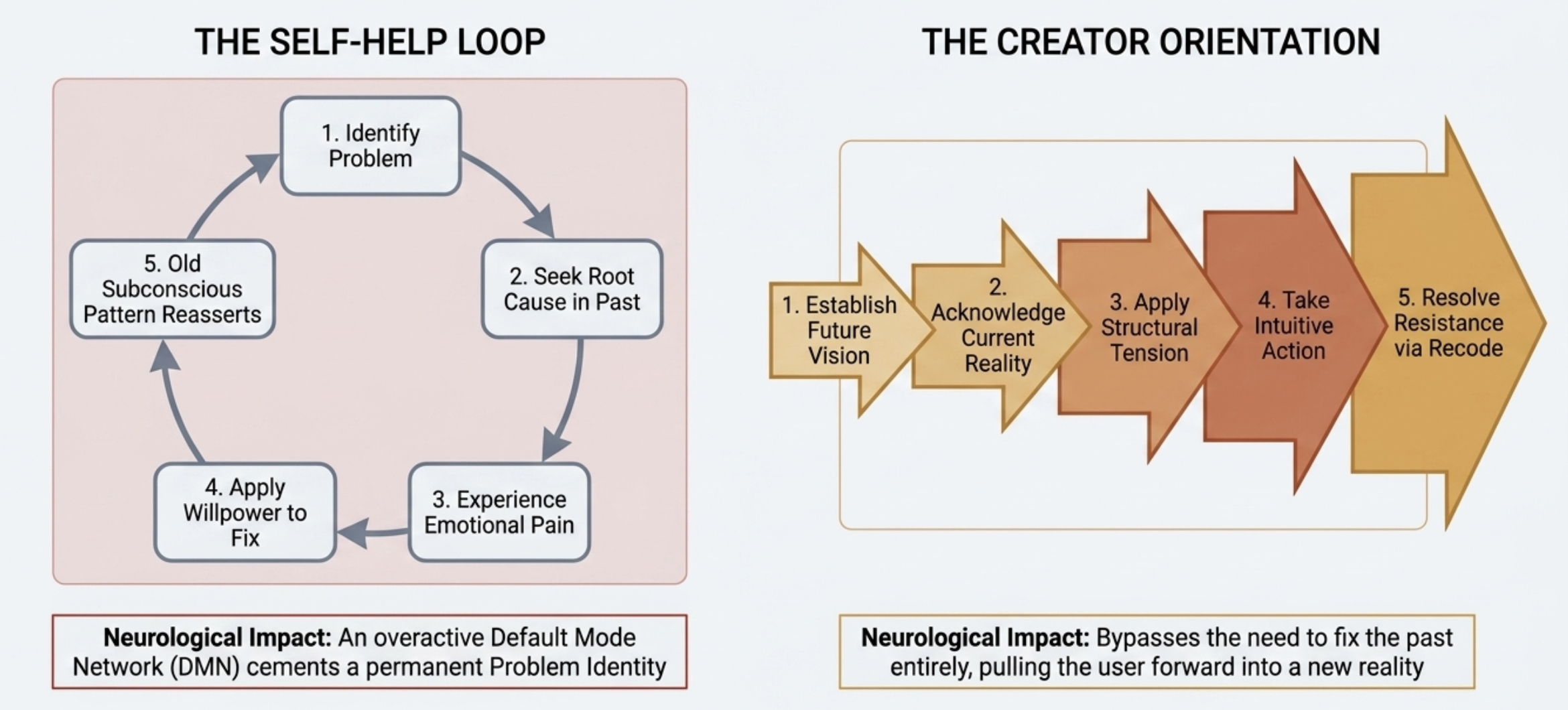
The Self-Help Loop keeps reinforcing the “problem” identity. The Creator Orientation — the structure behind a Recode — moves you toward the outcome instead.
Three things tend to make this faster than more familiar approaches:
It skips the “fix what’s broken” loop. A lot of traditional self-help and talk-based work spends significant time analyzing what’s wrong with you. Every round of that analysis can quietly reinforce the identity of being someone with a problem. The Recode starts from a different premise — you’re not broken, you’re choosing a new pattern — which removes a layer of work entirely.
You don’t have to relive the story. Traditional talk therapy often involves retelling painful experiences in detail, which can be valuable but can also be slow and, at times, re-activating. A Recode works with the pattern directly rather than requiring you to narrate it, which is part of why sessions can move faster without being less thorough.
It works with your unconscious bandwidth, not against it. Your conscious mind processes information relatively slowly compared to your unconscious — commonly cited estimates put it at a small fraction of the total. Relying on willpower alone means your conscious intentions are constantly fighting an unconscious system built to keep you exactly where you’ve always been — like walking forward on a treadmill tied to a bungee cord. Updating the unconscious pattern directly, instead of trying to override it consciously every day, is what makes the change feel like it sticks rather than something you have to maintain through effort.
What This Looks Like Working With Me
Trained directly under Christopher Duncan. Built around your specific pattern — not a script.
I work with this process one-on-one and in small groups rather than large public programs. If any of this sounds like the gap between where you are and where you know you’re capable of being, let’s talk.
Common Questions
Frequently Asked Questions
What is a Superconscious Recode?
It’s a guided coaching process that identifies the subconscious belief or emotional pattern blocking a specific goal, then works with imagery, structured language, and nervous-system regulation to update that pattern at its root — rather than trying to override it with willpower or positive thinking.
How long does it take to see results from a Recode?
Because the process works directly with the pattern causing the resistance, many clients notice a shift within a single session or a short series of sessions, rather than the months or years sometimes associated with purely talk-based approaches — though the exact timeline depends on the pattern involved.
Is a Superconscious Recode the same as hypnosis or therapy?
It’s related but distinct. It shares some tools with hypnotherapy (guided imagery, relaxed focus) and draws on the same memory-reconsolidation research used in some therapeutic approaches, but it isn’t clinical therapy and doesn’t diagnose or treat mental health conditions — it’s a coaching process focused on identity and goal-level blocks.
Do I have to talk about my trauma in detail during a session?
No. The process is designed to work with the pattern at the superconscious level without requiring you to narrate painful memories out loud in detail, which is part of what makes it feel gentler and more private than some talk-based approaches.
What is memory reconsolidation and why does it matter here?
It’s a well-documented area of neuroscience showing that emotional memories become temporarily flexible when reactivated, opening a window where they can be genuinely updated rather than just suppressed. It matters because it’s the mechanism that explains why this kind of work can create lasting change rather than temporary relief.